


Why banks and insurers should start listening to their customers now
March 2, 2026
-
6min read

Pascal Sollberger
Co-Founder & Marketing Expert, hypt

Customers today have many ways to share their opinions, such as through advisory meetings, app reviews, social media, online reviews, or emails. For banks and insurers, it is becoming increasingly crucial to systematically capture this feedback, understand it, and translate it into concrete improvements.
A professionally structured feedback management system provides far more than just snapshots of customer satisfaction. It serves as a strategic steering tool for product development, service processes, and the overall Customer Experience (CX). Those who consistently listen to the voice of their customers gain loyalty, trust, and long-term business success, laying the foundation for sustainable improvement.
This is precisely what so-called Voice-of-the-Customer (VoC) programs are designed for: structured approaches to systematically collect customer feedback, analyze it, and translate it into concrete actions.
Content
What is a Voice of the Customer (VoC) Program?
Voice of the Customer encompasses all activities through which companies systematically collect customer feedback, analyze it, and translate it into actionable measures. Unlike pure social listening, VoC covers all relevant touchpoints along the customer journey:
- Direct: Surveys (NPS, CSAT, CES), advisory meetings, focus groups
- Indirect: Social media, online reviews, forums
- Derived: Usage data from apps, web analytics, support tickets
The goal is to obtain a holistic view of the customer experience and identify concrete areas for action across products, services, and processes.
Why Banks and Insurers Need VoC
The strategic importance of Customer Experience is well established. Current studies show:
- According to Salesforce CX research, 80% of customers say that Customer Experience is just as important as a company’s products or services.
- 78% of customers would switch to another provider after a bad experience.
Ignoring customer expectations puts loyalty, revenue, and market share at risk. A professional VoC program makes the voice of the customer measurable, comparable, and most importantly actionable.
Benefits of a VoC Program
A systematic VoC program creates value across multiple areas of the business:
Product Development
- Identifies challenges and concrete customer needs directly from the target group
- Detects bugs and weaknesses early
- Prioritizes product features based on actual customer demand
Customer Service & Support
- Reduces support effort through targeted self-service offerings
- Optimizes wait times and processes based on real feedback
- Increases Customer Satisfaction Score (CSAT) and customer loyalty
- Enables continuous quality control and ensures service standards through systematic feedback monitoring
Marketing & Sales
- Provides reliable insights into customer expectations, objections, and needs
- Supports targeted campaigns and personalization
- Increases conversion as well as up- and cross-selling potential
Strategy & Management
- Aligns products, services, and offerings consistently with customer needs
- Identifies problems, dissatisfaction, and churn risks early, enabling proactive measures
- Provides data-driven decision-making foundations for strategic and operational initiatives
- Enables company-wide management of the Customer Experience
- Promotes a culture where customer feedback is systematically collected, taken seriously, and actively applied
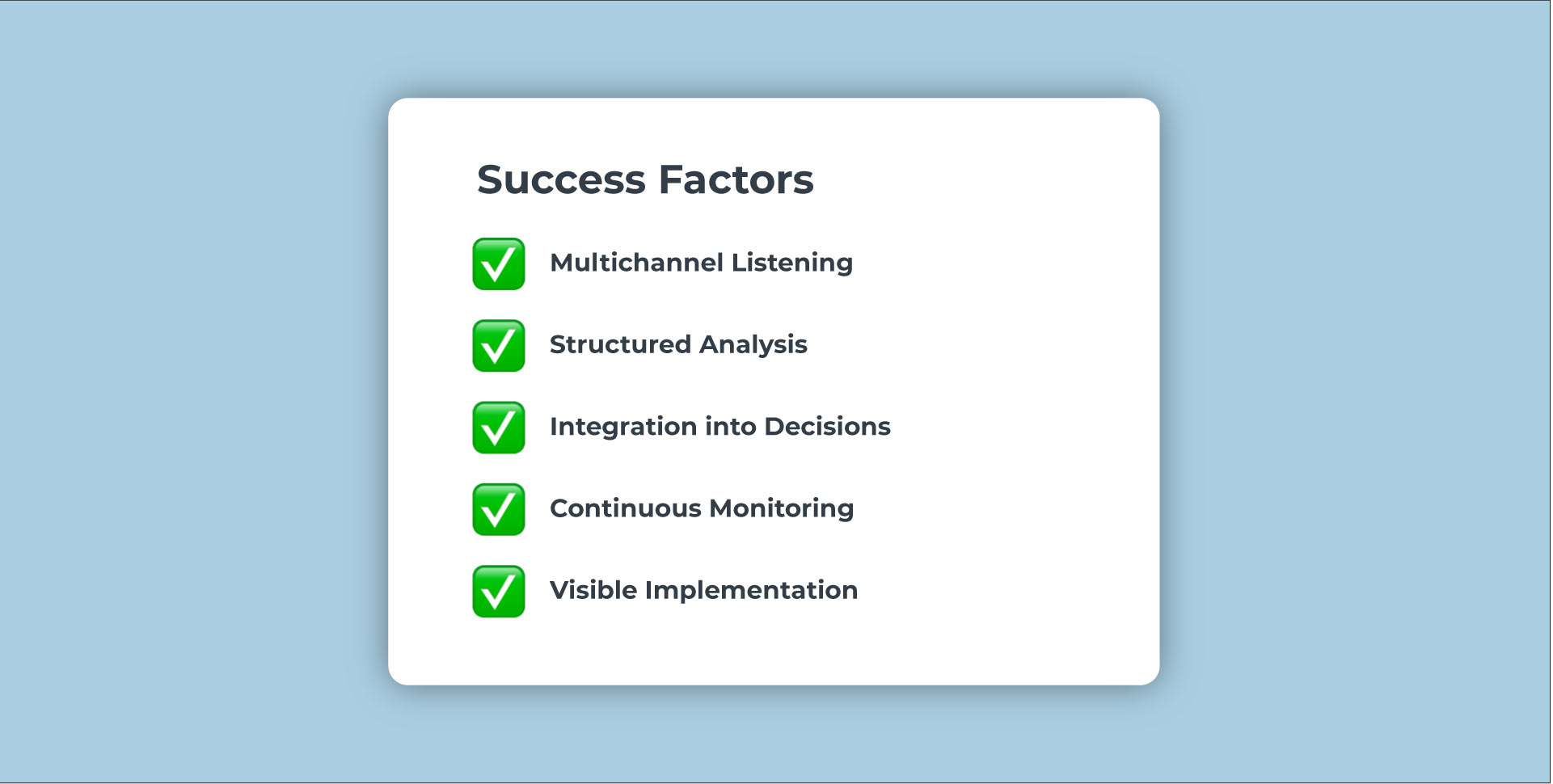
Success Factors for an Effective VoC Program
- Multichannel Listening: Consider all relevant channels, not just surveys
- Structured Analysis: Consolidate feedback, prioritize it, and identify trends based on data
- Integration into Decisions: Insights feed directly into strategic and operational decisions—from roadmaps and product development to process optimization and concrete offering decisions, such as which supplemental insurance products to develop, adjust, or prioritize
- Continuous Monitoring: Establish regular tracking and transparent reporting
- Visible Implementation: Customers need to feel that their feedback has a real impact
Approach: Putting VoC into Practice
A VoC program can be implemented step by step:
- Define Goals: Improve customer experience, reduce churn, optimize products
- Identify Touchpoints: Advisory sessions, digital channels, social media, support
- Select Methods: Surveys, feedback management tools, focus groups, social listening, web analytics
- Centralize Data: Use an integrated platform instead of isolated data silos
- Systematically Analyze Feedback: Identify patterns, understand root causes, set priorities
- Derive Insights and Act Consistently: Implement quick wins, optimize processes, initiate strategic initiatives
Tip: Don’t just collect feedback—prioritize it at key moments in the customer lifecycle and translate it into concrete actions, for example during onboarding, claims handling, or digital services.
Long Story Short
Voice of the Customer is far more than just a collection of surveys or reviews. It is a strategic management tool that enables banks and insurers to identify customer needs early, improve services purposefully, and develop products with a customer-centric focus. Those who actively listen to their customers and consistently translate feedback into decisions build trust, loyalty, and business relevance—today and in the future.